
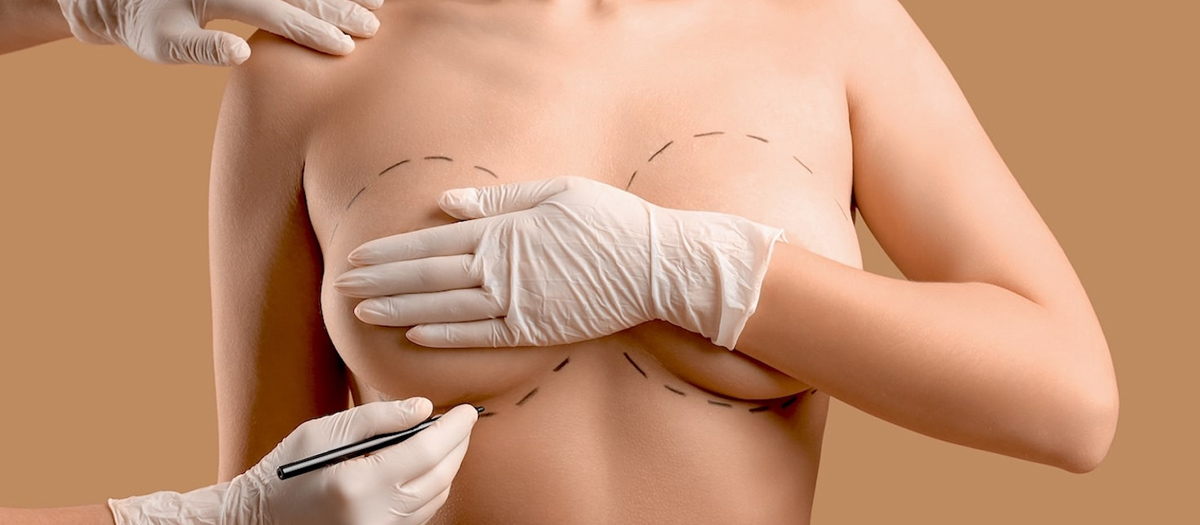
Breast augmentation surgery is a surgical procedure that changes the size and shape of the breast. In women who think that their breasts are too small, in women with unilateral breast development disorder/asymmetry due to congenital or acquired reasons, breast augmentation surgery can be performed for breast reconstruction after breast cancer surgery. This procedure is usually done using permanent silicone prostheses. Injecting mixtures of stem cells and oil prepared from your own oil is also an alternative method.
In some patients, it may be necessary to use these two methods together. All breast implants have a silicone sheath on the outside; however, two different types of prostheses are used as ingredients: those filled with salt water called silicone gel or saline. Depending on their shape, anatomical (drop-anatomical prosthesis) or round-shaped prostheses can be used. Which prosthesis will be used varies according to the shape of the breast and the breast structure. The most basic difference between them is that compared to the round prosthesis, the teardrop-shaped prostheses provide less fullness in the upper half of the chest.
There is no evidence that breast prostheses affect fertility, pregnancy, or breastfeeding ability. Breast prostheses, which have been proven to be durable by various biomechanical tests, only tear in the sheath and leakage in the material inside occur if they encounter a cutting or piercing object. The contents of silicone or saline leak into the surrounding tissues. In this case, the prosthesis needs to be replaced. In saline prostheses, sodium chloride spreading to the surrounding tissue is absorbed by the body in a short time.
However, if there is a tear in the prosthetic sheath filled with silicone gel, it can result in two ways. If the sheath is torn but nothing happens to the capsule around the prosthesis, you may not feel any changes. But especially if the capsule tissue surrounding the prosthesis is torn after excessive pressure, the silicone gel can spread to the surrounding tissue. However, in the new type of silicone prostheses used today, even if the silicone sheath explodes, the silicone in the content has started to be produced in a way that does not spread to the environment.
Therefore, only a distortion occurs in the image. In both cases, the prosthesis needs to be replaced. In a small number of women with breast dentures, scleroderma and arthritis-like diseases have been reported. Symptoms in these patients include joint pain or swelling, fever, weakness and breast pain. However, in the researches, a link between silicone breast prostheses and the symptoms defined as “connective tissue disease” could not be established.
We have no evidence that breast prostheses cause breast cancer, only the method of cancer screening with mammography changes in patients with breast prostheses. However, when you want to have a routine mammogram, this will not be a problem in radiology centers where technicians and physicians experienced in special techniques to obtain reliable X-ray images of the prosthesis together with the breast. Additional imaging methods such as MRI may be required. Ultrasonography may provide additional benefits in detecting breast masses and evaluating the prosthesis in some women with prosthesis.
As with any surgery, breast augmentation surgery has risks and specific complications specific to it.
Around the prosthesis, a layer formed by the body develops over time. This layer, known as the capsule, can sometimes compress the prosthesis and cause the prosthesis to be displaced, the breasts to look asymmetrical and the breasts to harden. This condition, known as capsular contracture (contraction), can be treated in a variety of ways and sometimes requires the removal or release of the tissue that compresses the prosthesis, and sometimes the implant is removed and replaced with a new one.
As with any surgery, bleeding, infection, delay in wound healing may also occur in breast augmentation surgeries. If the bleeding continues, a second surgery may be necessary to control the bleeding and drain the accumulated blood. In a small proportion of patients with prosthesis, infection may develop around or inside the prosthesis. The infection can occur at any time but is most common within the first week after surgery. In some cases, it may be necessary to remove the prosthesis and then replace it with a new one until the infection is completely under control. After surgery, sometimes there may be excessive sensitivity or decrease in sensation in the nipples. In the areas close to the incisions made during surgery, there may be small numb areas in the form of patches.
These sensations usually disappear over time, but may be permanent in some patients. In recent years, it has been demonstrated that there is a risk of developing some type of lymphoma inside the capsule that naturally forms around silicone breast prostheses. This disease, called anaplastic large cell lymphoma (BIA-ALCL) associated with breast prosthesis, is not a type of breast cancer. It is a type of cancer originating from lymph cells and is a disease that occurs approximately 4-8 years after prosthesis surgery, usually with complaints such as swelling and pain on one side, rarely breast mass, stiffness, asymmetry and redness.
It can be treated by completely removing the prosthesis and the capsule around it. In case of delayed diagnosis or advanced disease, chemotherapy and/or radiotherapy may be required. Although it is a treatable disease, if neglected it can result in death. In the last year, statements have been made by health authorities in North America, Europe and Australia. According to recent reports, the number of patients in the world is 573, and the number of patients who have died due to this disease is 33.
Considering that there are more than 20 million silicone prosthesis patients in the world, although it is seen that it is a very rare disease, it is a health problem that must be taken seriously and that patients who use silicone prosthesis for aesthetic purposes or for breast cancer to remove the breast and make new breasts should be informed and enlightened. At your first application, your doctor will evaluate your health and decide which surgical technique is the most suitable for you according to the condition of your breasts and skin tone. If you have sagging breasts, your doctor may also recommend breast lift (hanging, lifting) (mastopexy) surgery.
Breast augmentation surgery is preferably performed under general anesthesia. In this case, you will sleep throughout the entire surgery. The placement of the prosthesis depends on your breast and breast structure and the preference of your surgeon. The surgical incision may be in the natural fold where the breast meets the chest wall or around the areola (dark area around the nipple) or in the armpit. All necessary efforts will be made to make an incision so that the resulting scars (scars) are as far out of sight as possible.
Your surgeon will work through the incision and lift it to form a pocket directly behind the breast tissue, under the chest wall muscles (pectoral muscles) or behind the supmuscular fascial plan, which we call the subfascial plan. In cases where the skin is too thin and the mammary gland is too inadequate, the back of the muscle is a good option for covering the prosthesis. In addition, there is a slight sagging in the chest and if this is to be removed only with a prosthesis without using an additional method, it is a more correct choice to place the prosthesis behind the mammary gland. In those who do intense sports, the back of the mammary gland, if a prosthesis filled with salt water is selected, the back of the muscle is preferred.
Situations in which multiple factors need to be considered are quite frequent, and decisions are made on a person-by-person basis. Then, prostheses of the desired size are placed in the opened space and the breasts are enlarged. Placing the prosthesis behind the chest muscle can cause more pain for several days after surgery compared to placing the prosthesis directly under the breast tissue. The surgery usually takes one to two hours to complete. In some patients, special pipes called “drains” may need to be placed inside.
The drains placed on the day after the operation are removed and the patient can be discharged. You may feel fatigue and tenderness for a few days after surgery, but you will be able to stand up within 24-48 hours. Most of your discomfort can be controlled with medications prescribed by your doctor. Within a few days, if you have one, your superficial dressings will be removed and you will be asked to use a special bra. You will wear this bra as recommended by your surgeon.
For 6 weeks after surgery, avoid heavy movements and sports that force the chest muscles, which we call the arm and pectoral muscles. After the operation, use the special bra recommended by your doctor for 6 weeks day and night. After breast augmentation surgery, you should not travel by plane for 7-10 days and swim for 1 month.
You can start work in a few days, depending on the level of activity your job requires.
You need to follow your surgeon’s advice about starting exercises and normal activities. Your breasts will probably be sensitive to direct stimulation for two to three weeks, so avoid this type of physical contact. After that, when there is no more pain in your breasts, usually three to four weeks after surgery, the feeling in the breasts will have returned to normal. Your scars will be hard and pink for at least six weeks. It will then remain the same size for several months, or even appear enlarged. After a few months, the scars will begin to fade, but they will never completely disappear.
Since women are satisfied with their newly acquired fuller appearance, the results of breast augmentation surgery in many women are satisfactory. Your decision to have breast augmentation surgery is entirely your own and no one else can understand it. What matters is how you feel. If you have achieved your goals, the surgery has been successful.
- Plastic Surgery
- Mommy Makeover
- Non-Surgical Facial Rejuvenation
- Leg Lift Surgery
- Bichectomy
- Lower Face Rejuvenation
- Rhinoplasty
- Jaw Tip Aesthetics
- Genital Aesthetics
- Blepharoplasty (Eyelid Surgery)
- Inward Nipple Operation
- Gynecomastia
- Hip Butt Aesthetics
- Abdominoplasty (Tummy Lift)
- Eye Brow Lift
- Otoplasty (Ear Aesthetics)
- Arm Stretching
- Liposuction
- Breast Augmentation Operation
- Breast Lifting Operation
- Reduction Mammaplasty
- Operations After Bariatric Surgery
- Mid Face Lift
- Fat Injections to the Face
- Non-Surgical Aesthetics
- Plastic surgery